Too Warm to Snow: The Drought of 2026
Only surpassed by 1934, Water Year 2026 is the second warmest on record in Idaho since measurements began in 1895. Warmer than average winter temperatures across the West lead to a widespread snow drought and severe water supply shortages this summer. While most of the West experienced the double whammy of below normal precipitation and warm temperatures, Idaho received near normal precipitation across most of the state. However, this precipitation often fell as rain rather than snow, leading to mid-winter flood events and extreme drought conditions this summer. In this talk, we will review the evolution of the snow drought, how spring conditions changed water supply outcomes and discuss the myriad of drought impacts felt across the state from this unusual winter.
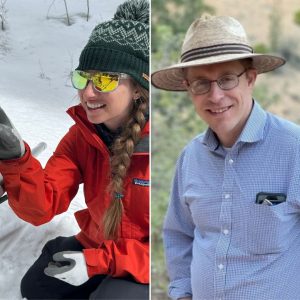
David Hoekema Ph.D., has worked as a hydrologist at the Idaho Department of Water Resources since 2013. He has a Master’s in Civil Engineering from Boise State University and a Ph.D. in Water Resources from the University of Idaho. David serves as the chair of the Idaho Water Supply Committee and shares the chair of the Idaho Drought Committee with Hannah Adams. The Idaho Water Supply Committee functions to keep the Governor and public informed about water supply conditions in Idaho and meets monthly from January to May, while the Idaho Drought Committee submits drought categorization suggestions for Idaho to the authors of the United States Drought Monitor.
In addition to water supply/drought monitoring David currently works on water right accounting in the Big Lost River (Basin 34), monitors return flows from the Twin Falls Canal Company to the Snake River, and models the surface water and groundwater interactions with the Snake River Planning Model on behalf of the Idaho Water Resource Board.
Erin Whorton is a hydrologist with Natural Resources Conservation Service (NRCS) on the Idaho Snow Survey team. Their mission is to provide high-quality, near real-time snowpack and meteorological data. Erin focuses on communicating snowpack, water supply, and drought conditions to the many people and entities whose operations rely on these data. She first became fascinated with the frozen water side of hydrology while earning her B.A in Chemistry and B.S. in Earth and Space Sciences at the University of Washington. An obsession with ice crystallized after traversing the Juneau Icefield, installing sensors in Antarctic glacier cliffs, and measuring streams flowing out of the Greenland Icesheet. This fieldwork prompted earning a M.S. in Geology from the University of Washington focused on Antarctic glacier dynamics. After working as wellsite geologist on oil rigs and a potash mine for five years, she was able to return to hydrology and worked on diverse cryohazard projects as a geologist for the State of Alaska in Fairbanks. Afterwards, she led the glacier research program at the USGS Washington Water Science Center for four years before moving to Idaho in 2020. She loves skiing, gardening, roller skating and reading in a hammock in her free time.