Large wood and large disturbances: the supply and geomorphic impact of in-stream wood following fire, snow avalanches, and more
Large-scale forest disturbance events have a measurable impact on the geomorphic processes operating within forested watersheds, but the degree of that influence from a given disturbance event remains under-constrained. Because such events may impact streams and rivers in various ways, including increased large wood and sediment supply, better understanding of the manner in which disturbance events alter geomorphic processes in forested streams is necessary to predict stream response to any future event.
In this talk, we will discuss these particulars for different forest disturbance mechanisms, including snow avalanches and fire.
Snow avalanches appear to substantially increase wood supply to mountain streams (> 80~500% more wood than unimpacted reference locations) and result in characteristic in-stream jam morphologies unique to this mechanism.
Fire, on the other hand, likely increases wood loading at the watershed-scale, but reach scale impacts may be influenced by local characteristics including valley morphology and burn severity.
Together, a majority of wood supplied by these mechanisms has an observable geomorphic impact at the reach- to watershed-scale, suggesting that wood supply is a notable mechanistic pathway via which large disturbance events may influence stream morphology. Overall, results will help to inform recovery-focused management decisions such as wood addition to streams following disturbance and provide managers and decision makers with improved perspective regarding post-disturbance stream trajectories.
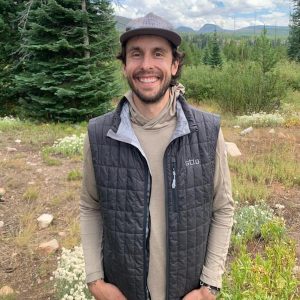
John is a fluvial geomorphologist and watershed scientist who studies the transport of material (sediment, wood, nutrients, etc.) through river basins to understand how river landscapes act, react, and evolve as connected networks of processes. His research primarily uses field-based measurements and sampling in conjunction with statistical and machine learning techniques to understand how watersheds are connected across time and space.
John received a PhD from the Department of Geosciences at Colorado State University, an MS in Environmental Engineering from the University of Maryland Baltimore County and a BS in Geology from the University of Maryland. John is a new Assistant Professor (just started this fall) in the Department of Geosciences at Idaho State University.
Outside of research John enjoys skiing, writing, and worrying about football.